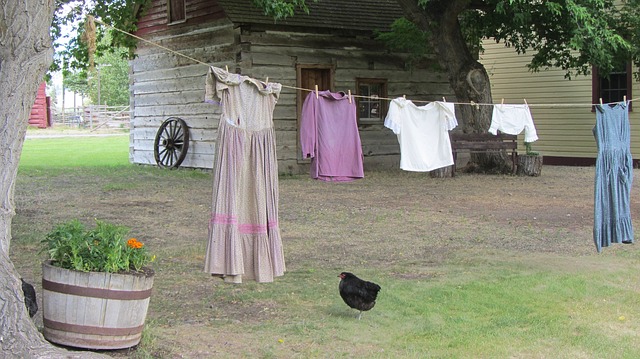
Imagine the quintessential country house in your mind’s eye. I bet it probably includes chickens scattered in the yard, an old faithful hound resting on the porch of a white, clapboard single (or two-story) house with a big porch and perhaps a rocking chair or two nestled beneath it. I always think of a clothesline in the background, clothes flapping in the breeze, bathed in sunshine.
What seems like such an iconic image of rural living could actually be one way to live a little greener: the clothesline. Consider how much energy a dryer consumes with each cycle. Even though they usually get more energy efficient with each new model or style, it is still one major draw on your electric usage. According to energyusecalculator.com, “energy use of a dryer varies between 1800 watts and 5000 watts, a typical dryer will use around 3000 watts.” Their website offers a handy calculator to put a dollar value to your energy usage: http://energyusecalculator.com/electricity_clothesdryer.htm. While it may not seem like a big cost, that’s just more resources being used up when there are greener alternatives like the clothesline.
There are a wide range of clothesline options, believe it or not. My husband’s memaw had two large, metal T-shaped frames set up in the yard with four strands of metal line running between them. These frames could bear quite a bit of wet laundry and since their place was near the top of the hill, breezes were blowing through more often than not. They have been a permanent fixture in her yard for many years. I have also seen a clothesline that was retractable across a room in another home. It was just a single line but I could imagine that would be very handy for drying delicate undergarments without taking up a whole lot of space.
When my mother lived in Germany, her neighbor had a clothesline that was shaped like a spinning wheel of sorts, parallel with the ground, and it spun around a single axis. I Googled this one to see what it’s called and it is a “fixed head rotary”. You can’t fold it down to minimize the space it takes up but the contraption would spin around the single axis so you could stand in one place and hang up a lot of clothing. I always wondered if you spun it hard enough, would the clothes and water separate like blood platelets in a centrifuge? I never got the courage to ask.
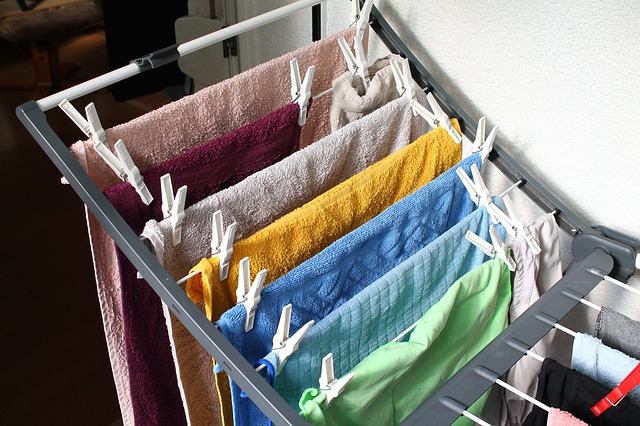
My mom, however, did not have such a feature on her rental property. Instead, she opted to purchase a number of drying racks that could be folded up and stored when not in use. When I asked why she didn’t use the dryer, she said that with electric prices being what they were, the drying racks saved her quite a bit of money each month. Even since she moved back to the United States, I think she has continued to use the drying racks to help her clothes last longer. The damage a dryer can do to my clothing isn’t really something I considered but after reading labels and realizing how much of my clothing contains synthetic materials, it does make sense that repeated exposure to the high heat of a dryer would cause them to break down faster. Another point to consider when purchasing clothes, I suppose.
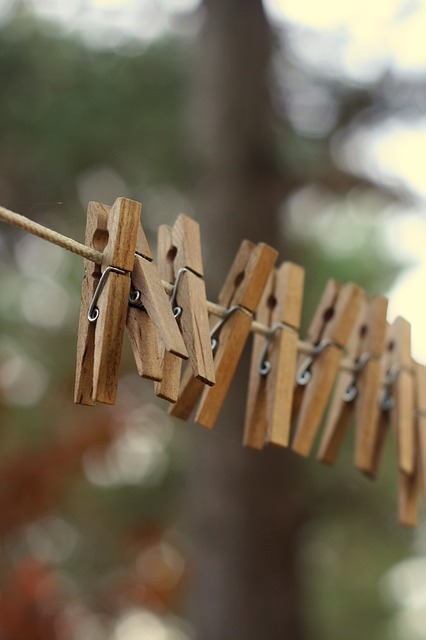
If you decide to try out drying clothes on a clothesline or drying rack, there are so many things to think about besides the type of clothesline you’re going to use. You need to consider what kind of cord should be used (https://breezecatcher-clothesline.com/blogs/outdoor-clothesline/different-types-of-clothesline-cord-and-how-to-choose-them explains a few materials). You also need to think about how you hang up your clothing and the best weather conditions. There are some great tips on this blogger’s website (https://farmingmybackyard.com/sunshine-im-line-drying/) including the use of clothespins rather than draping your clothing over the line to improve drying efficiency. Who would have thought to hang t-shirts upside down so you don’t get weird pulling at the shoulders from the clothespins? Or that direct sunlight can act as a disinfectant?
My husband loves the smell of clothing or sheets that have dried on the line outside. I can’t tell a difference in smell, to be honest. I just take his word for it. My biggest complaint about line drying is that the clothing feels stiff but I think I will be applying a few tips from http://www.thespruce.com (www.thespruce.com/how-to-keep-line-dried-clothes-from-getting-stiff-1387965) to see if that helps me out.
So if you decide to try out line drying your clothes, let us know how it goes! May you have plentiful breezes and sunshine to get things dried! Go green, fellow Texans!
 Going Green In Texas